Data Architecture
MongoDB or SQL Server for a New .NET Application?
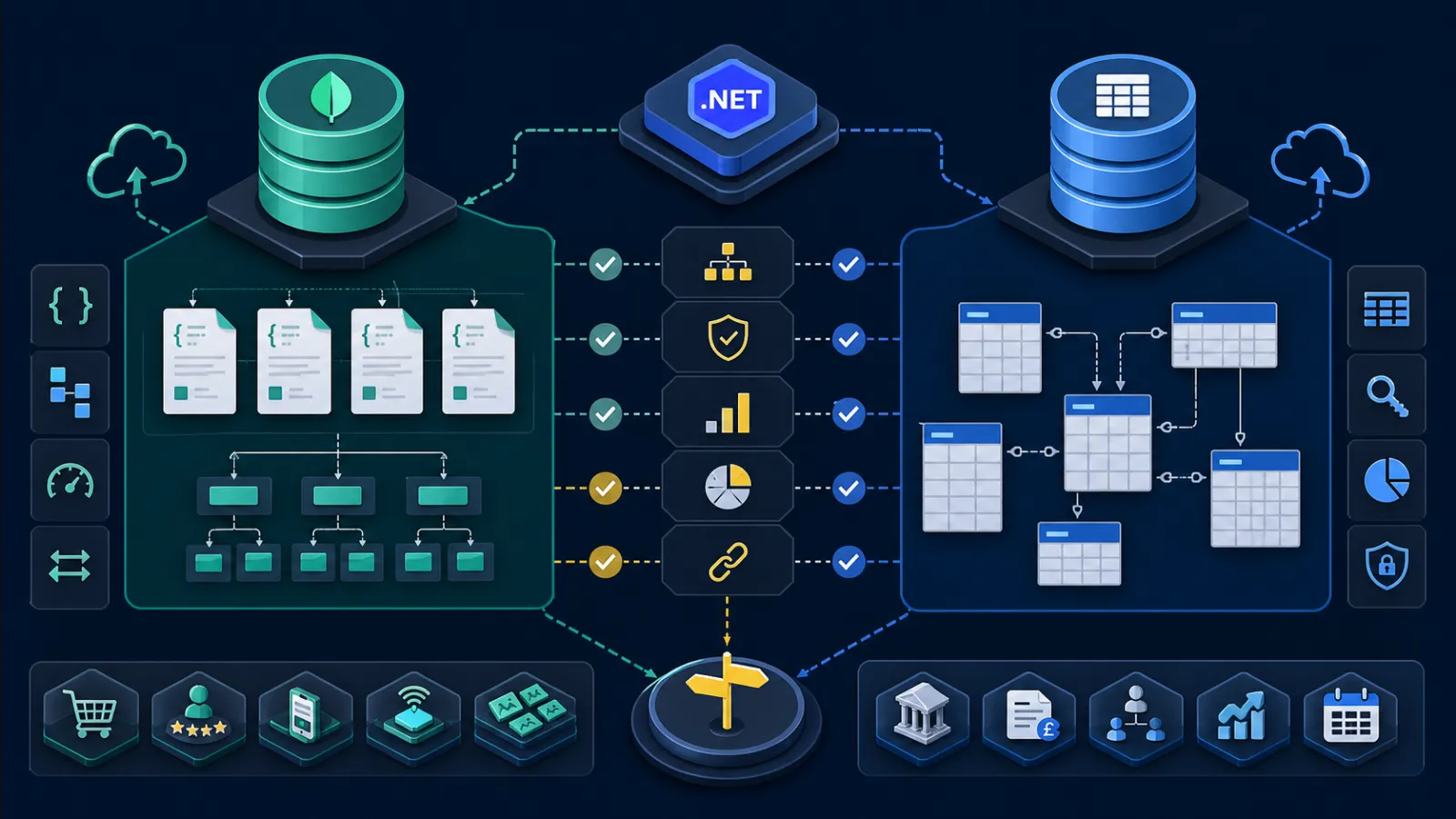
Choose a database from invariants, access patterns and operational capability-not from whether the current JSON object looks document-shaped. Both products can model more than their stereotypes suggest.
Prototype the irreversible assumptions
A proof of concept that creates, reads, updates and deletes one entity proves SDK familiarity. A useful prototype loads realistic volume, exercises the hardest aggregate update, runs the awkward cross-cutting report, applies a schema evolution and restores data after failure.
Include operational evidence: query plans, index size, write contention, replication behaviour and migration duration. Test with the team that will support the result. The goal is not to crown a benchmark winner; it is to discover whether the preferred model keeps business rules and failure understandable when the sample data stops being small and tidy.
“Our data is JSON” is not a database requirement
Almost every modern API exchanges JSON, including applications backed by SQL Server. Likewise, MongoDB can model references and transactions; it is not limited to unstructured blobs. Choosing from the transport shape confuses how data arrives with how the business must protect and query it.
Begin with invariants: what facts must change together, which relationships must remain valid and where uniqueness matters. Then list dominant reads and writes, reporting needs, growth, retention and operating constraints. The database is responsible for preserving important truths under concurrency, not merely serialising C# objects conveniently.
The decision is often less dramatic than advocates imply. Both can serve ordinary business applications well. The useful question is which model makes the difficult parts explicit and which failure modes the team can operate confidently.
Aggregate boundaries are the strongest MongoDB signal
A document works well when a business aggregate is normally loaded and changed as one unit: an order with a bounded collection of lines, a survey submission or a product snapshot. Embedding keeps related data together and makes atomic updates inside that document natural.
Embedding is weaker when children grow without bound, are shared independently or need frequent queries across parents. A customer containing every historical event eventually becomes a huge hot document. Splitting those children into collections reintroduces references and coordination.
Do not equate object graphs with aggregates. An ORM navigation property may traverse half the database, while a real aggregate is a consistency boundary small enough to update atomically. Model from business ownership, not the shape produced by one screen.

Relational constraints are executable business rules
SQL Server can enforce foreign keys, unique constraints and checks across normalized structures. Those controls protect data from every writer, including imports, administration and code paths that bypass application validation.
MongoDB supports schema validation and unique indexes, but cross-document relationships are more commonly enforced by application logic. That may be an acceptable trade when the domain naturally fits independent aggregates; it is risky when correctness depends on many cross-record rules.
Application validation and database constraints are complementary. The application gives users meaningful errors; the database resolves races. “We checked first” does not prevent two concurrent requests creating the same supposedly unique record.
Transactions do not make the models equivalent
SQL Server's relational transaction model makes multi-row, multi-table changes ordinary. MongoDB supports multi-document transactions, but needing them frequently may indicate that the chosen document boundaries fight the domain.
A transaction solves atomicity on one database boundary. It does not make calls to payment providers, queues or email atomic. Both designs need outbox patterns, idempotency and reconciliation when work crosses systems.
Long transactions reduce concurrency and increase operational risk in either platform. Keep them focused on preserving invariants, not on holding locks while waiting for remote services or user interaction.
Query patterns decide whether denormalisation helps
MongoDB often trades duplication for read locality. A copied customer name can make an order self-contained and preserve historical meaning. It also creates a decision: should later customer edits update old orders, and how will partial propagation be repaired?
SQL joins express relationships flexibly, but unbounded joins and ORM-generated query graphs can still perform badly. Indexes must follow actual predicates, ordering and selectivity. Neither product saves a team from understanding query plans.
Write down the ten most valuable queries, expected result size and latency. Include support, export and reconciliation-not only customer screens. A model optimised for one aggregate may be painful for cross-customer reporting.
Reporting often shifts the balance toward relational structure
Business applications accumulate questions nobody predicted. SQL's mature joins, grouping and BI ecosystem make exploratory and operational reporting straightforward when data is relational. A normalized schema also gives analysts shared meanings rather than several embedded copies.
MongoDB aggregation pipelines are capable, but deeply nested or polymorphic documents can make cross-aggregate reporting harder. Copying data into a warehouse or analytical store may be the right design at scale, yet that creates pipelines, freshness and reconciliation work.
Do not force transactional storage to serve every analytical query. Whichever database owns operations can publish governed events or extracts into a reporting model designed for its workload.
Flexible schema transfers responsibility; it does not remove schema
MongoDB documents can vary, which helps when records legitimately have different shapes or features evolve quickly. The application still needs to interpret every historical shape. Optional fields, changed meanings and renamed properties become a versioning problem.
Store an explicit schema or document version and migrate deliberately. “Read old, write new” can spread migration cost across traffic but leaves rarely read records old indefinitely. Batch migration gives a clear end state but needs capacity, rollback and monitoring.
SQL migrations make schema change visible and coordinated. That friction can be valuable because incompatible changes receive review. Expand-and-contract deployment-add, backfill, switch, remove-avoids assuming application and database update simultaneously.
Concurrency needs a policy in both databases
Last-write-wins silently discards work when two users edit the same record. Use row versions, concurrency tokens or conditional updates and decide how conflicts appear to users. MongoDB's atomic document update helps inside one aggregate; SQL can use optimistic or pessimistic controls according to the workflow.
Atomic operators prevent lost increments but do not resolve semantic conflicts. Two individually valid changes can make a business object invalid together. Put the invariant at the transaction or aggregate boundary.
Distributed replicas also introduce read-consistency choices. Reading from replicas can reduce primary load and latency but may show stale state after a write. Decide which journeys require read-your-writes rather than applying one read preference globally.
Multi-tenancy changes the operational calculation
Shared collections or tables provide high density but require tenant scope in every query, index and unique constraint. Dedicated databases strengthen isolation and per-tenant recovery but create a fleet of schemas, connections and migrations.
MongoDB partitioning and SQL sharding both require a stable routing key. Cross-shard queries, tenant moves and rebalancing are product capabilities, not configuration flags. A poor tenant or shard key can create hotspots even when total capacity looks ample.
Consider noisy neighbours, encryption keys, residency, backup granularity and customer-specific restoration. The right answer may be mixed: shared infrastructure for most tenants and dedicated deployment for exceptional isolation needs.
Operations should break the tie
Ask who will monitor, back up, restore, tune indexes, manage capacity and respond at 02:00. A database familiar to the operating team can be safer than a theoretically elegant unfamiliar choice. Managed services reduce infrastructure work but not data modelling, query diagnosis or recovery ownership.
Test restoration, not backup creation. Understand point-in-time recovery, replica failover, regional design and the effect on acknowledged writes. Recovery objectives should come from business loss tolerance rather than vendor feature tables.
Observe slow queries, connection pools, lock or contention behaviour, replication lag, storage growth and index use. Schemaless data does not mean administrationless data; relational maturity does not make poor queries harmless.
Avoid choosing both by default
Polyglot persistence can give each workload an appropriate store, but it introduces duplicated data, distributed transactions, multiple security models, monitoring and specialist knowledge. “Use MongoDB for flexibility and SQL for reporting” leaves unanswered which owns each fact.
Add a second database when a measured workload or isolation requirement justifies the operational cost. Keep ownership explicit and move data through durable, reconcilable pipelines. Do not dual-write from a request and hope both commits agree.
For many teams, one well-modelled database is the maintainable choice. The burden of proving a second technology valuable belongs to the proposal, not to sceptics.
Decision guide
| Pressure | Often favours SQL Server | Often favours MongoDB |
|---|---|---|
| Consistency | Many cross-entity constraints | Independent document aggregates |
| Queries | Relational and evolving reports | Known aggregate-centric reads |
| Shape | Shared structured semantics | Legitimate polymorphism |
| Evolution | Coordinated schema migrations | Mixed document versions accepted |
| Team | Strong relational operations | Strong document modelling experience |
Choose SQL Server when relationships, constraints and broad reporting dominate. Choose MongoDB when bounded documents, aggregate-local operations and variable shapes are fundamental. Prototype the hardest query, migration and recovery path before committing; CRUD on a sample entity proves almost nothing.