Software Delivery
How to Choose a Software Development Partner
Choose a software partner by examining how it reduces uncertainty, protects your ownership and behaves when delivery becomes difficult. Presentations and portfolios matter less than the evidence behind decisions, releases and long-term support.
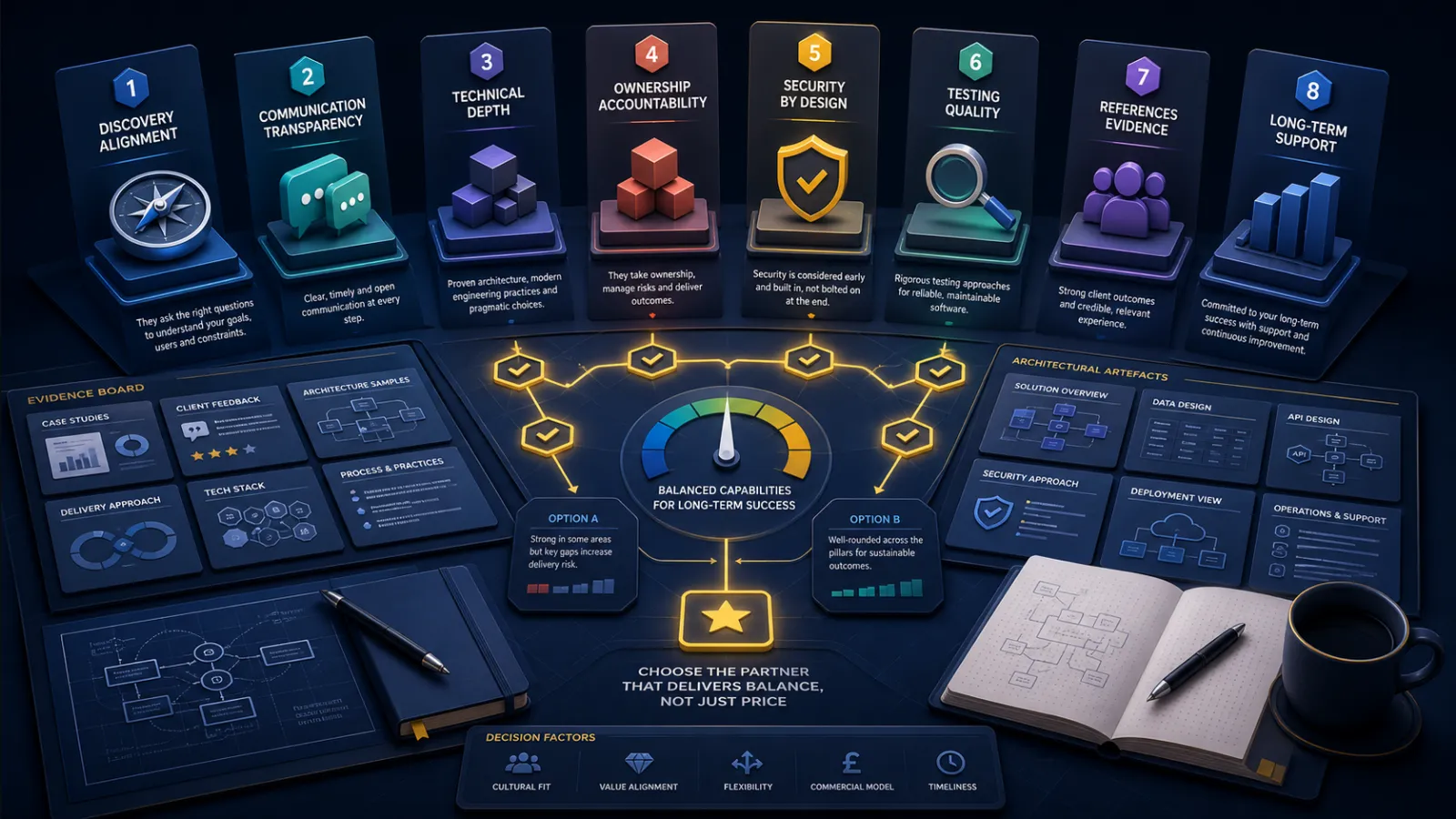
Buy a working relationship, not a proposal document
Software projects contain incomplete requirements, changing priorities and production surprises. The partner's value is not merely writing code to instruction; it is helping the organisation make sound decisions and remain accountable for outcomes.
A strong sales team can produce an impressive proposal without representing the people who will deliver. Evaluate the actual team, working practices, artefacts and behaviour under challenge.
Define what kind of partner is needed: temporary capacity, a specialist integration, product delivery, legacy modernisation or long-term ownership. The best supplier for one is not automatically best for another.

Test whether they investigate before prescribing
A credible partner asks about outcomes, users, current workflow, data, constraints and operating responsibility before recommending a stack or fixed architecture.
Ask for an example where discovery changed the proposed solution, reduced scope or recommended a product instead of bespoke development. If every discovery leads to the supplier's preferred platform, it may be a sales stage.
The partner should explain what it knows, assumes and needs to test. Confidence is valuable; false certainty is expensive.
Meet the people who will perform the work
Understand named roles, seniority, allocation, location and substitution. Ask who owns product decisions, architecture, quality, security, deployment and support.
Interview key delivery people using a real project scenario. Listen for questions, trade-offs and production concerns-not trivia. Verify that senior experts remain involved beyond initiation and review.
A small stable team can outperform a larger rotating one because domain knowledge compounds. Ask about expected continuity and how knowledge survives unavoidable staff changes.
Technical depth appears in trade-offs
A mature partner can explain why an option fits, when it would not and what it costs to operate. Beware universal preferences for microservices, serverless, low-code or a particular cloud.
Use one representative risk: multi-tenancy, offline operation, data migration or high-volume integration. Ask how the team would investigate it, what could fail and what evidence it would seek before committing.
Architecture should match team and business capability. Complexity sold as sophistication becomes the client's support burden.
Inspect quality evidence rather than methodology labels
“Agile”, code review and automated testing are claims. Ask to see anonymised examples of a pull-request standard, pipeline gates, test strategy, release checklist, decision record and incident review.
Good quality is risk-based. Pure business rules need different evidence from database behaviour, accessibility or disaster recovery. A large unit-test count can coexist with weak release confidence.
Ask how defects are triaged, escaped defects influence the system and technical debt is made visible commercially.
Security belongs in normal delivery
The partner should discuss threat modelling, dependency management, secrets, authorisation, data handling, logging, environment access, patching and incident responsibilities-not only a final penetration test.
Check how privileged supplier access is granted, reviewed and removed. Repositories, cloud subscriptions and production data should use named identities and least privilege.
Certifications can support assurance but do not prove the proposed application design. Ask for evidence tied to your data and trust boundaries.
Ownership must be practical
Contractual source-code ownership is insufficient if repositories, build pipelines, infrastructure, credentials and documentation remain solely under supplier control. Agree where these assets live and who can access them.
Clarify rights to bespoke code, pre-existing libraries, third-party components and generated assets. Understand licence obligations and whether another team can lawfully and practically operate the system.
Data export should preserve attachments, relationships, history and audit where required. Test exit thinking before the relationship begins.
Commercial incentives shape engineering behaviour
| Commercial approach | Useful when | Question to ask |
|---|---|---|
| Fixed scope and price | Acceptance and dependencies are well understood | How are ambiguity and legitimate learning handled? |
| Time and materials | Priorities will change as evidence emerges | How are budget, outcomes and productivity governed? |
| Capped increments | Work can deliver bounded outcomes sequentially | Who funds cross-increment foundations and retirement? |
| Managed service | Continuing operation needs defined responsibility | Which service levels, exclusions and enhancement capacity apply? |
No model removes risk. Look for transparent assumptions, sensible change control and incentives that do not reward hiding uncertainty or maximising billable scope.
Communication quality is decision quality
Status reports should make outcomes, risks, decisions, spend and forecast visible. A permanent “green” status until late failure indicates weak escalation, not smooth delivery.
Ask how the partner handles disagreement, missed forecasts and stakeholder delay. Strong teams raise risks early, present options and state consequences without using technical language to avoid accountability.
The client also has duties: timely decisions, subject-matter access and clear priority. A credible partner will say so.
References should test behaviour over time
Speak with clients whose project resembles your complexity and lifecycle, not merely sector. Ask what changed after contract, how forecasts behaved, how incidents were handled and whether the client could access and understand its software.
Request a reference from a system in support, not only a recent launch. Long-term maintainability, upgrades and responsiveness appear later.
Respect confidentiality, but treat an inability to provide any independently verifiable evidence as a risk.
Support begins in architecture and handover
Clarify warranty, service hours, severity, response, recovery, monitoring, patching and third-party responsibilities. An acknowledgement time is not a restoration time.
Ask who receives alerts, how incidents are reproduced and whether support staff are connected to product knowledge. A separate help desk with no engineering path creates delay.
Discuss lifecycle upgrades and enhancement planning. Software needs continued ownership even when feature delivery slows.
Use a paid discovery or pilot as mutual due diligence
A bounded engagement reveals more than repeated sales meetings. Choose a real decision or vertical slice and evaluate how the partner learns, documents, communicates and challenges assumptions.
Define useful outputs and ownership. Do not make the pilot an unpaid competition that encourages superficial prototypes or transfers excessive intellectual property.
The client should be free to proceed, pause or take clear outputs elsewhere. Confidence earned through openness is stronger than lock-in.
A practical evaluation scorecard
| Area | Evidence | Warning sign |
|---|---|---|
| Discovery | Options, assumptions and experiments | Solution selected before investigation |
| Team | Named people, allocation and continuity | Senior sales presence, unknown delivery team |
| Engineering | Trade-offs, tests, pipelines and decisions | Methodology claims without artefacts |
| Security | Controls integrated through lifecycle | Reliance on final penetration testing |
| Ownership | Accessible code, infrastructure, data and documentation | Operational dependency hidden behind IP wording |
| Commercial | Transparent assumptions and change governance | Low price with vague scope and exclusions |
| Operation | Support, recovery and lifecycle responsibilities | Relationship ends at launch |
Weight the scorecard before proposals arrive. Mandatory risks should be pass/fail rather than averaged away by an attractive presentation.
Red flags worth investigating
- A precise estimate before access to users, data or integrations.
- A preferred architecture for every problem.
- No direct access to the proposed delivery team.
- Quality described only through test counts or a final test phase.
- Security and accessibility treated as optional extras.
- Client repositories or cloud access discouraged without reason.
- References limited to launch success and testimonials.
- Support, upgrades and supplier exit absent from the proposal.
Questions to ask finalists
- What would make you recommend that we do not build this?
- Which assumption creates the largest estimate range, and how would you test it?
- Who will work with us, and what competing commitments do they have?
- Show how a production incident changed your engineering practice.
- How will we access code, environments, telemetry and documentation?
- How do you distinguish support from enhancement?
- What happens commercially when evidence changes scope?
- How would another supplier take over responsibly?
Evaluate cultural fit through working conditions
“Cultural fit” can become a vague preference for people who communicate similarly. Replace it with observable conditions: willingness to challenge, comfort with written decisions, response to bad news, expectations of client availability and how conflict is resolved.
Include accessibility for participants, meeting load, time-zone overlap and the balance between synchronous discussion and focused work. Friendly workshops can still be incompatible with the client's governance or decision pace. Do not mistake agreement and social chemistry for the ability to expose risks respectfully.
Related C3 Software guides
Frequently asked questions
Should price decide the shortlist?
Price matters only after scope, team, assurance, ownership and lifecycle assumptions are normalised. The cheapest proposal may describe a materially smaller obligation.
Is sector experience essential?
It helps where domain rules are difficult, but comparable complexity, learning ability and production evidence can matter more than a familiar logo.
Should the partner own the cloud account?
Usually the client should retain appropriate ownership and access, with the supplier granted governed permissions. The model should support audit and transition.
How can a small engagement reduce selection risk?
A paid discovery or bounded production slice exposes the team's actual reasoning, communication and engineering practices before a larger commitment.
Choose evidence you can still trust after the sales process
If you need a partner for discovery, bespoke delivery or modernisation, talk to C3 Software about the outcome, risks and practical ownership model.