Business Software
Build or Buy? Choosing the Right Business Software Strategy
Build versus buy is not a contest between flexibility and speed. It is a decision about where the business needs control, which constraints it can accept and who will carry the cost of change over the software's useful life.
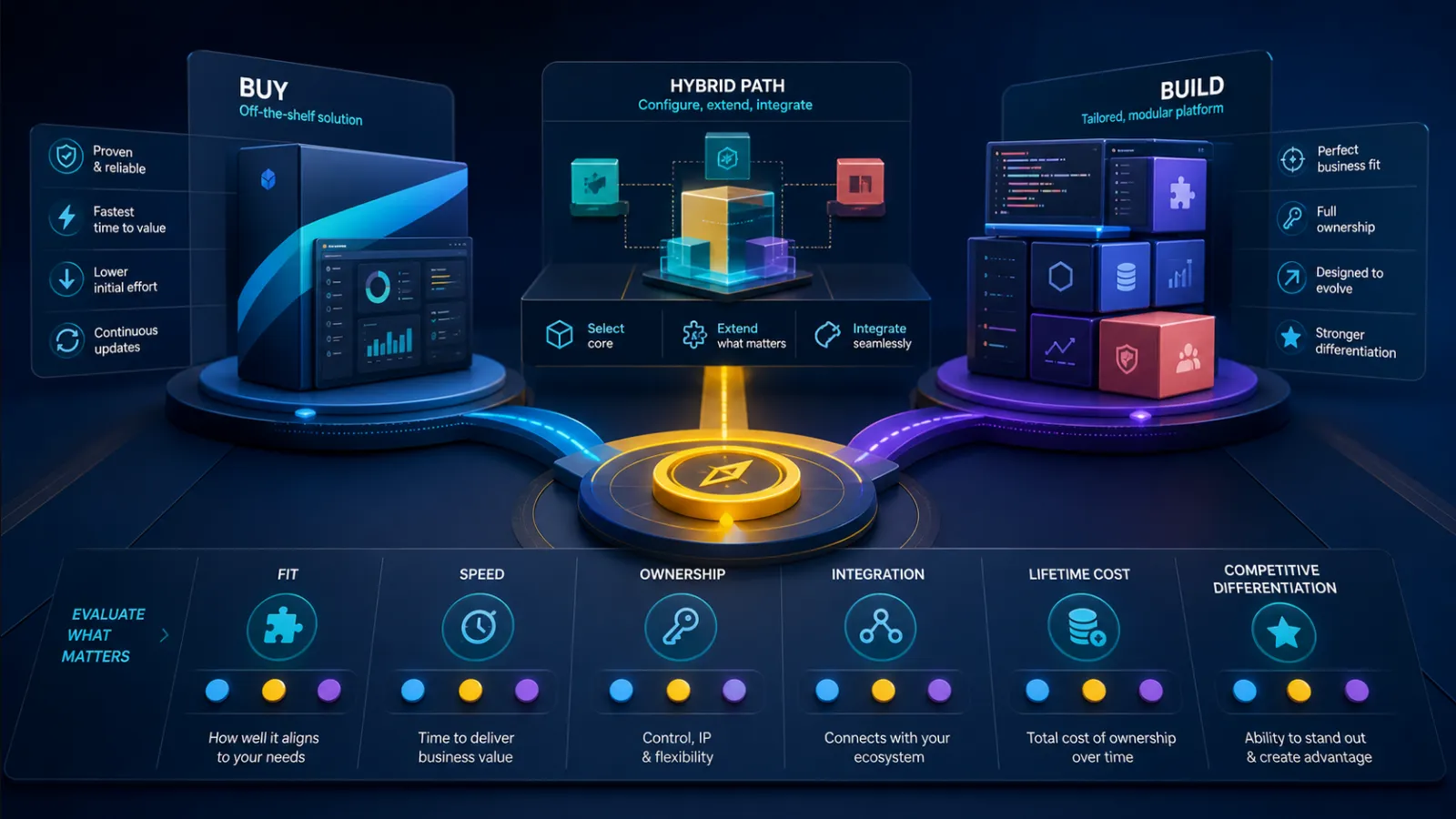
Start with the capability, not the product category
“CRM”, “portal” and “workflow system” are too broad for a useful build-or-buy decision. Break the need into capabilities: customer identity, case routing, pricing, document capture, payments, reporting and audit. Different capabilities may deserve different answers.
The core question is whether the way the organisation performs that capability creates meaningful advantage or simply reflects habit. Payroll and commodity accounting rarely justify bespoke implementation. A distinctive pricing model, regulated evidence workflow or partner experience might.
Do not confuse uniqueness with differentiation. A process can be unique because it accumulated exceptions over twenty years. Building those exceptions into new software preserves cost rather than advantage.
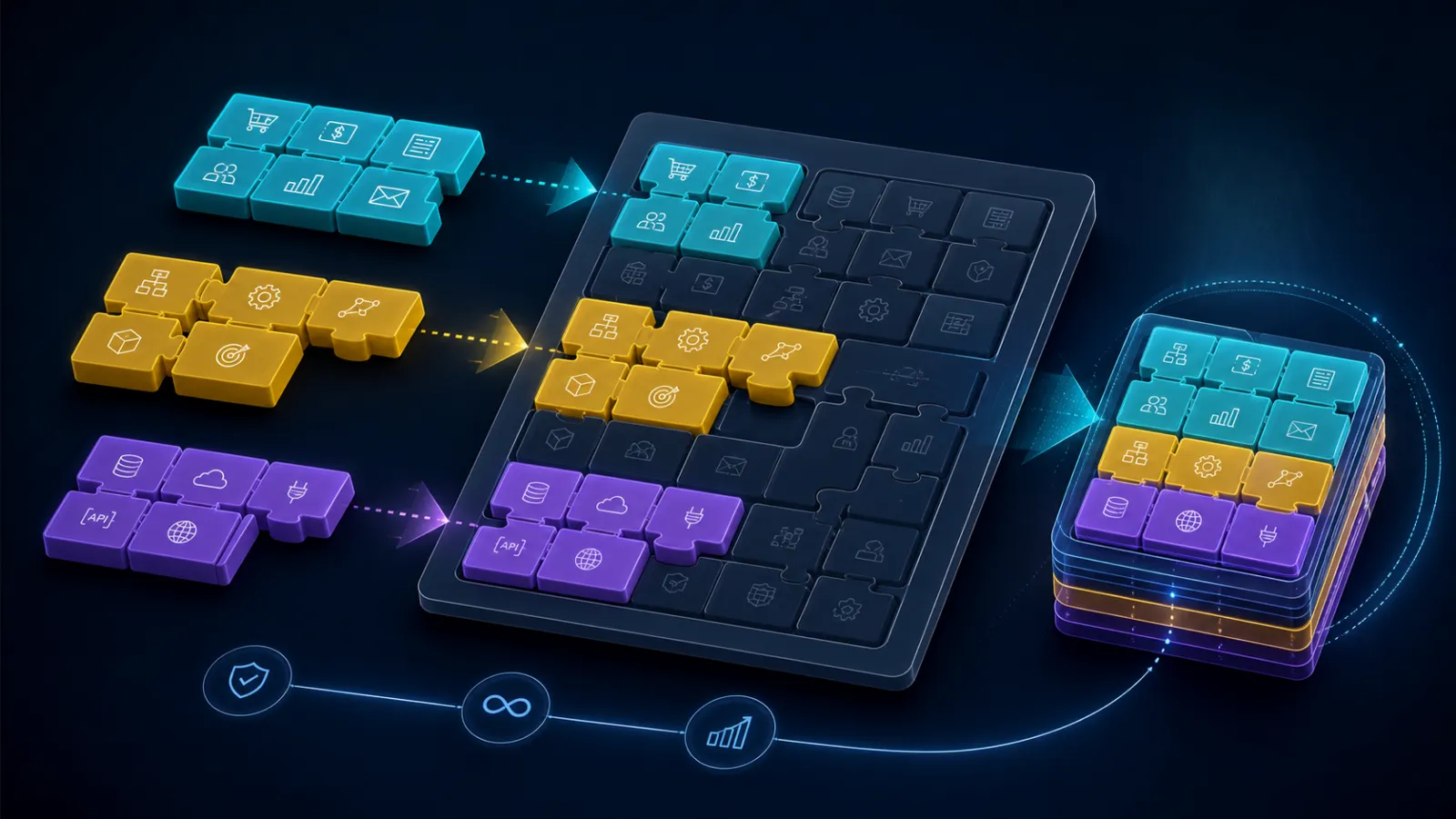
Buying exchanges design control for shared economics
A product spreads development, security and support costs across customers. It can provide mature features, faster adoption and a maintained compliance posture that one organisation would struggle to reproduce economically.
The exchange is constraint. The vendor owns roadmap, data model, release timing and commercial terms. Configuration can alter supported behaviour; heavy customisation often creates an unofficial fork that is difficult to upgrade.
Evaluate fit using real journeys and exceptions, not a feature checklist. Most products can demonstrate that they “support approvals”. The relevant questions are whether they support your delegation, evidence, separation-of-duties and correction rules without manual work around the product.
Building buys ownership, not permanent freedom
Bespoke software can model the organisation's language, integrate around its data and evolve with its priorities. It does not remove constraints; it transfers responsibility for product decisions, security, availability, accessibility, support and lifecycle to the organisation and its partner.
Owning source code is not the same as owning the capability. Practical ownership requires documentation, build access, deployment rights, data portability, transferable knowledge and the ability to appoint another competent team.
Build where control over the workflow or pace of change has durable value. Do not build merely to avoid subscription fees: internal ownership has a continuing cost even after initial development is capitalised.
Hybrid is an architecture, not a safe middle answer
Most organisations combine products and bespoke components. A custom customer portal may use a purchased CRM, payment provider and identity platform. This is sensible when ownership boundaries match capabilities.
Hybrid fails when responsibilities are ambiguous. Which system owns customer status? Where is a pricing rule executed? What happens when a product API is delayed? Who reconciles a partially completed workflow?
Budget the joins. Integration, identity mapping, error recovery, vendor upgrades and observability can dominate the cost. “Best of breed” becomes worst of integration when every product has a different customer identifier and no authoritative owner.
Score strategic fit before implementation fit
| Decision factor | Evidence favouring buy | Evidence favouring build |
|---|---|---|
| Differentiation | The process is standard and adaptation is acceptable | The capability materially affects customer or operating advantage |
| Requirements | A mature product fits important journeys without invasive customisation | Distinctive rules are stable enough to encode and valuable enough to own |
| Time | Urgency is high and implementation can follow a proven product route | A narrow bespoke slice can deliver value without waiting for a broad platform rollout |
| Change | Vendor roadmap and cadence align with expected needs | The business needs control over priority and release timing |
| Ownership | The organisation accepts vendor dependency and contract controls | Data, rules and operational independence justify long-term product ownership |
| Economics | Shared product economics remain favourable at expected scale | Licence, customisation and workaround costs exceed sustainable bespoke ownership |
Weight factors before scoring options. Otherwise a preferred solution can be made to win by changing weights after the demonstration.
Feature fit is not process fit
Run vendors and proposed bespoke designs through end-to-end scenarios: normal work, exceptions, corrections, permissions changes, month-end and dependency failure. Include the people who perform and support the process.
A product that covers 90% of listed features may fail on the 10% that protects money or customer commitments. Conversely, teams often mark historical conveniences as mandatory and reject a product that would support a simpler process.
Classify gaps as adapt the process, configure, integrate, extend, accept or reject. Each response has a different cost and upgrade consequence.
Model total cost over the decision horizon
Compare options across the same period and usage assumptions. For products include implementation, licences, premium modules, environments, integrations, data migration, customisation, training, support, price escalation and exit.
For bespoke software include discovery, delivery, assurance, hosting, monitoring, support, platform upgrades, ongoing product decisions and future enhancement. Both options require internal subject-matter time and adoption work.
Use ranges and sensitivity analysis. User count, transaction volume, integration complexity and regulatory assurance may change the result more than the headline price.
Data portability is tested at exit, not promised at purchase
Ask what data can be exported, in what format, at what cost and whether attachments, history, relationships, audit and configuration are included. A CSV of current records is not a usable exit from a workflow product.
For bespoke work, ensure the organisation controls repositories, deployment configuration and database access appropriate to the agreement. Avoid undocumented infrastructure that only the supplier can recreate.
Perform a sample export or restoration before commitment where possible. Contract wording matters, but practical evidence reveals whether portability preserves business meaning.
Security and compliance do not automatically favour either side
A reputable product may offer mature certifications and controls, but the customer remains responsible for configuration, identities, data use and integrations. A compliant vendor does not make every implementation compliant.
Bespoke software allows controls to match the workflow but requires deliberate threat modelling, secure delivery and ongoing patching. “It is internal” is not a security design.
Assess data location, tenancy, access model, audit, incident duties, recovery objectives, subcontractors and deletion for every option. Compare evidence, not brand familiarity.
Time to first use can mislead
A product can be provisioned quickly while data migration, integration and operating change take months. A bespoke prototype can appear quickly while production assurance and exception handling remain unfinished.
Compare time to a completed, adopted business journey, not contract signature or demonstration. Identify dependencies on procurement, policy, data cleanup and user availability.
Urgency may justify an interim measure. Make its lifetime explicit so a tactical product or spreadsheet does not become the unplanned permanent platform.
Use discovery to test the expensive assumptions
Discovery should map outcomes, journeys, data, integration, volume, security and change expectations. Test product fit with configured scenarios; test bespoke uncertainty with prototypes or technical spikes.
The result may be a mixed strategy. Discovery is successful when it changes or sharpens the decision, not when it produces a longer specification for the option chosen in advance.
Decision traps
- Choosing a familiar brand before testing the difficult workflow.
- Calling current practice “differentiation” without evidence of value.
- Comparing product subscription with only bespoke build cost.
- Ignoring integration and reconciliation in a hybrid strategy.
- Assuming customisation remains compatible with vendor upgrades.
- Treating source-code ownership as operational independence.
- Leaving data exit and supplier transition until contract termination.
A practical decision sequence
- Define the business outcome and decision horizon.
- Split the need into capabilities and identify genuine differentiation.
- Map critical journeys, exceptions, data and controls.
- Shortlist buy, build and hybrid boundaries without choosing prematurely.
- Test the highest-cost assumptions using configured demos and technical evidence.
- Compare total cost, risk, time, ownership and exit on consistent assumptions.
- Record the choice, accepted constraints and triggers for review.
Revisit the decision when the economics change
A sound build-or-buy choice is contextual, not permanent. Vendor pricing, acquisition, regulation, transaction volume and the strategic importance of a capability can change the balance. Record the assumptions behind the original decision so later teams can recognise when it deserves review.
Watch leading indicators: growing customisation, recurring integration failures, roadmap conflicts, escalating licence tiers or bespoke maintenance consuming a disproportionate share of change capacity. Do not wait for contract renewal or a platform crisis to rediscover the decision.
Changing strategy does not always mean replacing immediately. Reducing customisation, extracting authoritative data or introducing a boundary can create a safer future exit.
Related C3 Software guides
Frequently asked questions
Is buying software always faster?
No. Provisioning is fast, but configuration, migration, integration, assurance and adoption determine time to a usable outcome.
When should a business build bespoke software?
When a durable, differentiating capability needs control over workflow, data or change and the organisation accepts continuing product ownership.
Is hybrid usually the best option?
Hybrid is common, not automatically best. It succeeds when ownership and failure behaviour at every boundary are explicit and economically justified.
How should options be compared?
Use real journeys and a common multi-year model covering fit, time, change, integration, security, operation and exit-not feature counts and headline prices.
Choose where software ownership creates value
C3 Software Limited has built and supported business software in the UK since 2001. If you need impartial evidence for a build, buy or hybrid decision, talk to C3 Software about a focused discovery and options assessment.