Business Software
The Hidden Cost of Maintaining Legacy Software
Legacy software is not expensive because it is old. It becomes expensive when ordinary change, recovery and assurance require disproportionate effort-and when that friction removes business choices faster than it appears in the IT budget.
Age is a poor measure of legacy risk
A fifteen-year-old application can be well understood, well tested and inexpensive to change. A three-year-old system can already be legacy if its vendor has disappeared, deployments are manual and every enhancement requires changes across tightly coupled components.
The useful definition is behavioural. Software has become legacy when the organisation depends on it but cannot change, operate or assure it at an acceptable cost and pace. This definition avoids two common mistakes: replacing stable software merely because it uses unfashionable technology, and retaining a dangerous system because its annual hosting invoice looks low.
Assess the gap between what the business needs and what the system can safely support. Technology age may contribute to that gap, but ownership, architecture, skills, documentation, deployment and data quality usually determine its size.
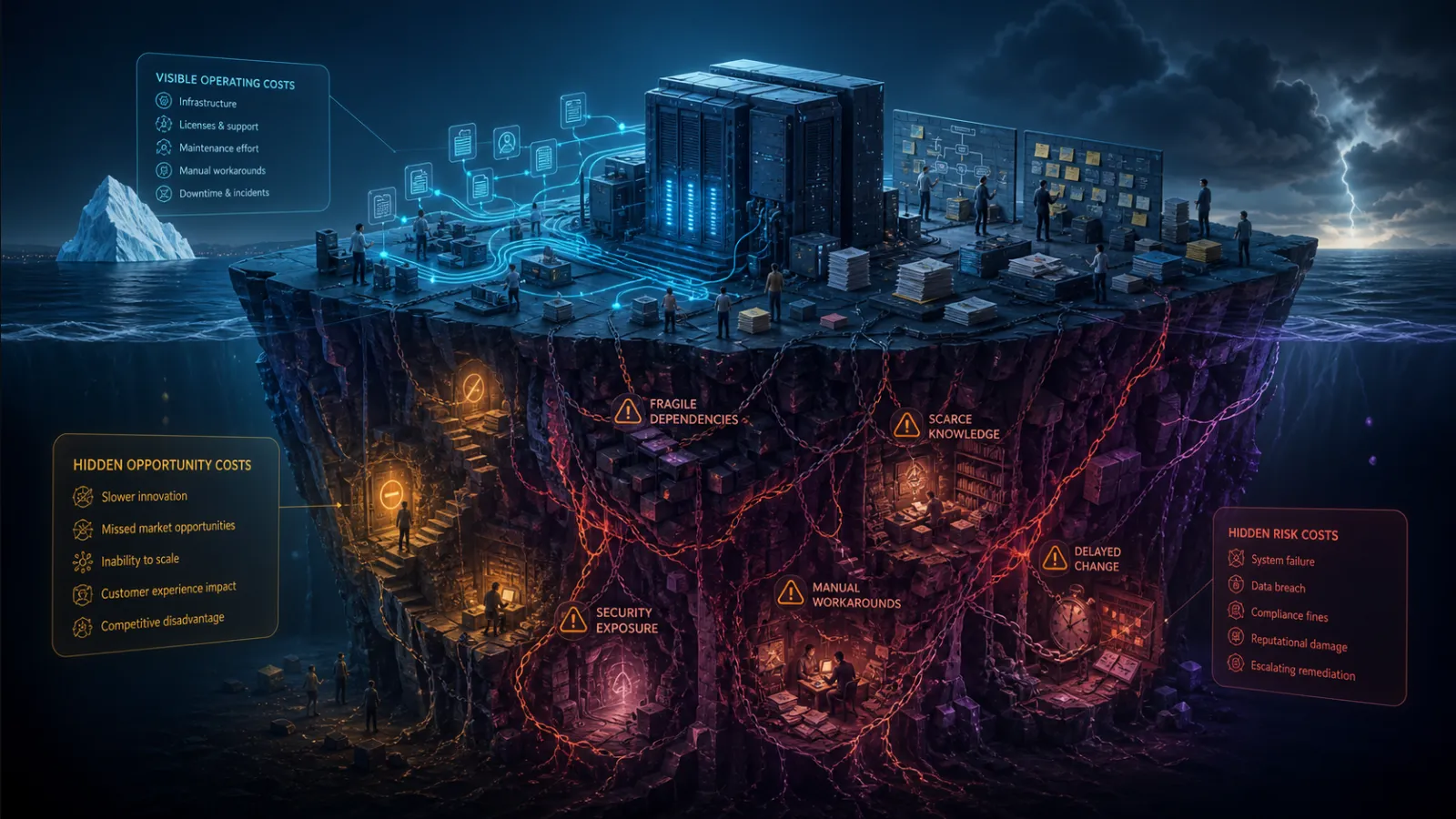
The maintenance invoice captures only the visible layer
Licences, hosting, vendor support and developer time are easy to see. The larger cost is distributed across departments: finance reconciles failed exports, operations rekeys data, customer service explains delays, security maintains exceptions and managers avoid changes whose delivery feels unpredictable.
These activities rarely carry a “legacy software” cost code. They appear as normal headcount, overtime, project contingency or missed revenue. That is why a system can look cheap in the technology budget while making the organisation expensive to run.
Create a whole-workflow view. Follow one frequent change and one operational failure from request to final resolution. Count waiting, approval, manual checking, duplicate entry and recovery-not only development hours.
Slow change compounds rather than remaining constant
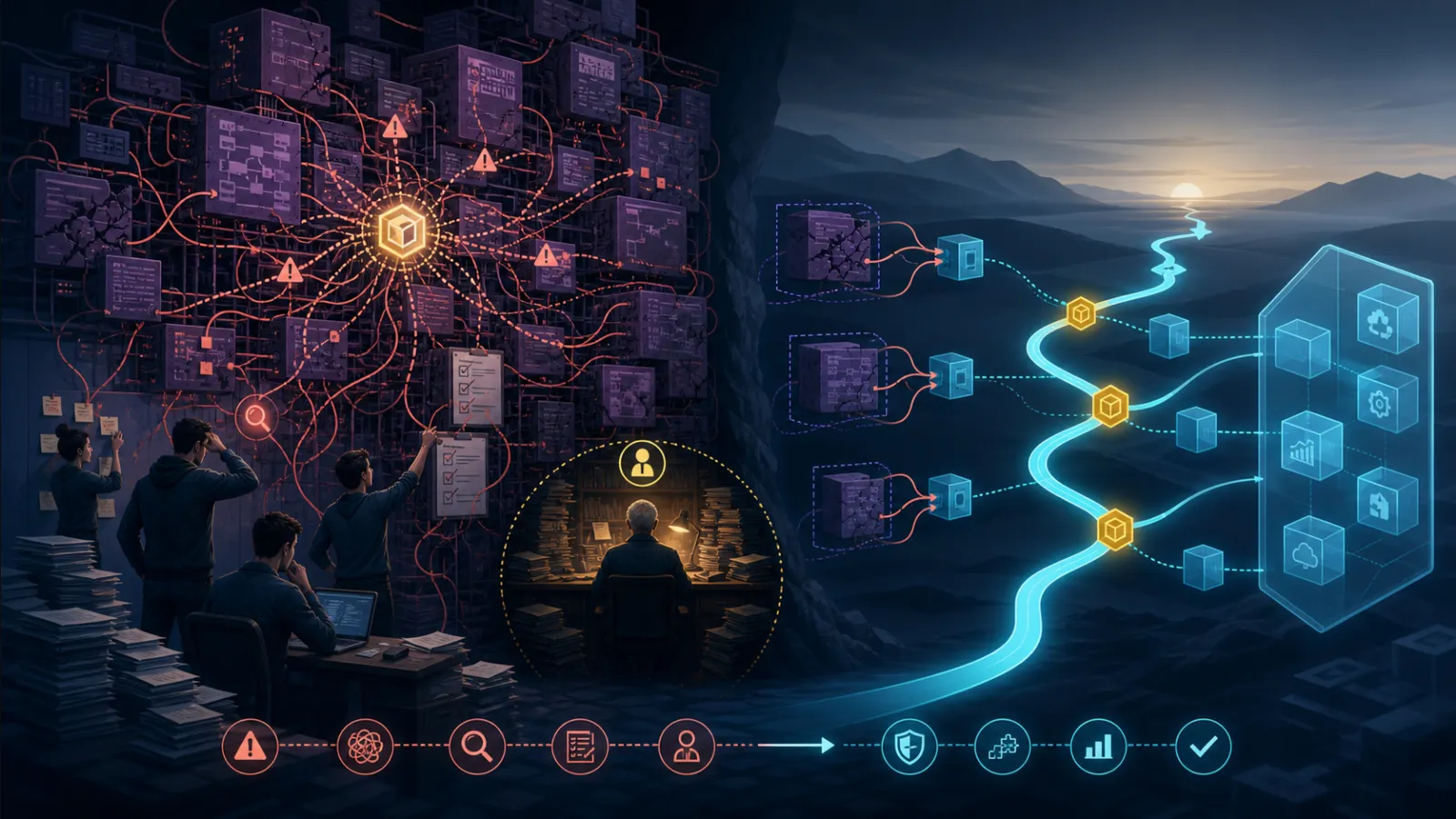
A small pricing or policy change may require impact analysis across shared tables, scheduled jobs, reports and undocumented integrations. Teams add larger estimates because testing and rollback are uncertain. Stakeholders then bundle more requirements into each release because releases are rare, making each release riskier.
This creates a reinforcing loop: large changes need more coordination, failures encourage more controls, and heavier controls further increase lead time. The apparent problem is developer speed; the deeper problem is that the system does not provide safe, observable boundaries for change.
Measure elapsed time from an agreed request to production, then separate active work from waiting. Long approval and test queues often reveal environment or ownership constraints that rewriting business logic alone will not fix.
Track the cost of a representative change over time. If the same class of change needs more people, regression scope or release coordination each year, maintenance cost is rising even when the annual invoice is flat.
Security cost includes everything the platform prevents
An unsupported runtime is an obvious exposure, but supported software can still impose legacy security constraints. The application may require obsolete authentication, broad database permissions, a flat network, shared administrator accounts or a browser configuration the rest of the organisation has retired.
Compensating controls have real cost. Firewalls, isolation, manual access reviews, exception registers and additional monitoring require design and ongoing evidence. They can reduce risk, but they do not make the underlying limitation disappear.
The less visible cost is blocked improvement. A system that cannot support modern identity, encryption, audit or patching practices may delay wider infrastructure change. One application can keep an old server estate or network route alive long after every other workload has moved.
Do not convert vulnerability counts directly into a replacement case. Assess exploitability, data sensitivity, exposure, recovery and the feasibility of controls. Urgent containment and long-term modernisation are related but different decisions.
Knowledge concentration is an operational dependency
The familiar “only one person understands it” problem is not solved by asking that person to write more documentation in spare moments. Their knowledge often includes diagnostic intuition, informal contacts, data correction procedures and the reason apparently redundant code must run in a particular order.
Measure concentration through work, not a document count. How many people can deploy, restore, investigate a failed batch, explain a critical business rule and grant access safely? When was each capability last exercised without the usual expert leading it?
The expert also pays a cost. They become the approval gate and incident responder, leaving little time to transfer knowledge or improve the system. Recruitment does not immediately solve this because new staff learn slowly in an environment with weak tests and unsafe experimentation.
Pair on real changes, rotate support with supervision, automate repeatable recovery and test runbooks. Knowledge becomes organisational only when another person can use it successfully under realistic conditions.
Manual workarounds are part of the system
Spreadsheets, email approvals and rekeying often compensate for missing software behaviour. Calling them “outside the system” hides their effect on correctness and auditability. They are an informal extension of the system, usually without transactional controls or reliable telemetry.
Some manual work is appropriate: judgement, exception handling and high-consequence approval may belong with people. The warning sign is repetitive translation needed because applications cannot exchange or validate information.
Measure volume, handling time, rework, queue age and error recovery. Avoid assuming every saved minute becomes cash; value may appear as additional capacity, faster service or reduced risk. State which benefit the investment case claims.
Fragile integrations tax every connected project
Legacy integrations often depend on shared folders, database tables, fixed-width files or undocumented timing. They may work reliably for years until volume, permissions or a supplier change exposes an assumption. Their stability can reflect a frozen environment rather than a robust contract.
Every new consumer pays to understand that contract and often creates another point-to-point adapter. The resulting cost belongs partly to the new project, so the legacy platform appears cheaper than it is.
Inventory producers, consumers, owners, schedules, data sensitivity and failure handling. A database query observed today may belong to a monthly or annual process, so short traffic samples cannot prove an interface is unused.
Wrapping a legacy system with an API can protect new consumers, but the adapter needs monitoring, security and a lifecycle. Without a migration or retirement purpose, it becomes one more permanent layer to support.
Downtime cost begins before the outage
Legacy operational cost includes oversized maintenance windows, deployment rehearsals, change freezes and the people placed on standby because recovery is uncertain. A system can report good availability while consuming substantial effort to preserve it.
Measure business interruption, degraded modes and recovery work separately. A failed overnight job may leave the web application online while preventing orders from shipping. Infrastructure uptime does not describe that business outage.
Recovery time in a plan is not evidence. Restore backups, rebuild environments and replay integrations under controlled conditions. Old systems often depend on licences, installers, certificates or external endpoints that no longer exist outside the running server.
Data can be both the system's value and its largest liability
Long-lived applications hold valuable history, but their schemas often encode old organisational structures, duplicate identities and inconsistent definitions. Reports may agree only because they reproduce the same historical exceptions.
Migration exposes these problems; it does not create them. Budget for profiling, ownership decisions, reconciliation and records that cannot be mapped automatically. A clean new interface over ambiguous data does not resolve the ambiguity.
Retention also becomes harder when old software cannot delete or isolate records safely. Keeping everything “just in case” increases storage, disclosure and compliance exposure. Establish which data has business or legal value and which is merely difficult to remove.
Opportunity cost is the option the business no longer has
The largest legacy cost is sometimes a decision never submitted. Teams stop proposing self-service, new pricing, acquisitions or partner integrations because experience says the system cannot support them in time. Those ideas leave no rejected ticket and no obvious ledger entry.
Opportunity cost should not be inflated into speculative revenue. Record concrete events: a tender requirement that could not be met, a product launch delayed, a market integration declined or staff added because volume could not be automated.
Speed has value only when the organisation can use it. Modernisation will not create benefit if policy, procurement or adoption remains the limiting constraint. A credible case distinguishes software constraints from wider operating constraints.
A practical legacy cost model
| Cost category | Evidence to collect | Common blind spot |
|---|---|---|
| Run | Hosting, licences, support, monitoring and routine administration | Shared infrastructure and unpaid out-of-hours support |
| Change | Lead time, active effort, regression scope and release coordination | Waiting and abandoned requests |
| Failure | Incidents, degraded workflows, recovery and reconciliation | Business outages hidden by server uptime |
| Assurance | Patching, access review, audit evidence and compensating controls | Security exceptions funded elsewhere |
| Manual operation | Rekeying, checking, spreadsheets, queues and corrections | Work treated as normal departmental activity |
| Opportunity | Delayed or declined changes with a documented business consequence | Speculative benefit with no observable event |
Use ranges and state assumptions. The model should support a decision, not manufacture precision. Compare the status quo with credible alternatives over the same period, including migration risk, dual running, training and the ongoing cost of the replacement.
Do not let sunk cost choose the future
Past investment explains how the organisation arrived here; it does not determine the best next action. Equally, accumulated frustration does not justify a rewrite without evidence. Compare future costs and risks from today.
A replacement also has legacy potential. Bespoke software can recreate undocumented rules, and a purchased product can impose expensive process changes or vendor dependence. The question is which option provides acceptable ownership, changeability and total cost for the expected business horizon.
Choose the intervention that matches the constraint
| Option | Appropriate when | What it will not solve |
|---|---|---|
| Stabilise | The system remains valuable but recovery, tests or security controls are weak | Fundamental product or platform limits |
| Rehost or replatform | Infrastructure or runtime operations are the main constraint | Tightly coupled business logic and poor data ownership |
| Incrementally modernise | Valuable capabilities can move behind controlled seams | A hard retirement deadline with no coexistence time |
| Replace with a product | The process is standard and adaptation is acceptable | Unique requirements without costly customisation |
| Rebuild | The capability is differentiating and existing constraints cannot be separated | Unknown behaviour or weak adoption planning |
| Retire | The business outcome is no longer needed or can be consolidated elsewhere | Data retention and dependent-consumer obligations |
Different parts of one application may deserve different treatments. Retire an unused module, wrap a stable calculation, replace commodity functionality and modernise the changing core. “The system” need not receive one all-or-nothing answer.
Build the case from one costly constraint
- Choose a frequent change, serious incident or blocked opportunity.
- Map the complete workflow, dependencies, waiting and manual recovery.
- Quantify current run, change, failure and assurance costs using ranges.
- Identify the smallest intervention that removes the dominant constraint.
- Test the riskiest assumption through discovery or a bounded technical spike.
- Define outcome measures and the condition for continuing, changing course or stopping.
This creates a decision the organisation can inspect. It is stronger than a generic claim that modern technology will be faster, safer and cheaper.
Related C3 Software guides
Frequently asked questions
When does software become legacy?
When the organisation still depends on it but can no longer change, operate or assure it at an acceptable cost and pace. Age alone is not the test.
Is maintaining legacy software always more expensive than replacement?
No. A stable system with modest future needs may be cheaper to retain and strengthen. Compare forward costs, risks and business options rather than assuming replacement wins.
How can hidden legacy costs be measured?
Combine technology spend with change lead time, incidents, assurance controls, manual work, knowledge concentration and documented blocked opportunities. Use ranges and explicit assumptions.
Should an organisation modernise or replace?
Modernise when valuable capabilities and data can move through safe seams. Replace when the process is standard or the existing constraints cannot be separated economically. Many portfolios need a mixture.
Make the cost of keeping the system visible
C3 Software Limited has built and supported business software in the UK since 2001. If an ageing application is restricting change or creating operational risk, talk to C3 Software about a focused legacy-system assessment and options review.