Business Software
How to Modernise Software Without Replacing Everything at Once
Modernisation does not require one enormous replacement programme. It requires deciding which capabilities still earn their place, which constraints must be removed first and how old and new software can coexist without becoming two permanent estates.
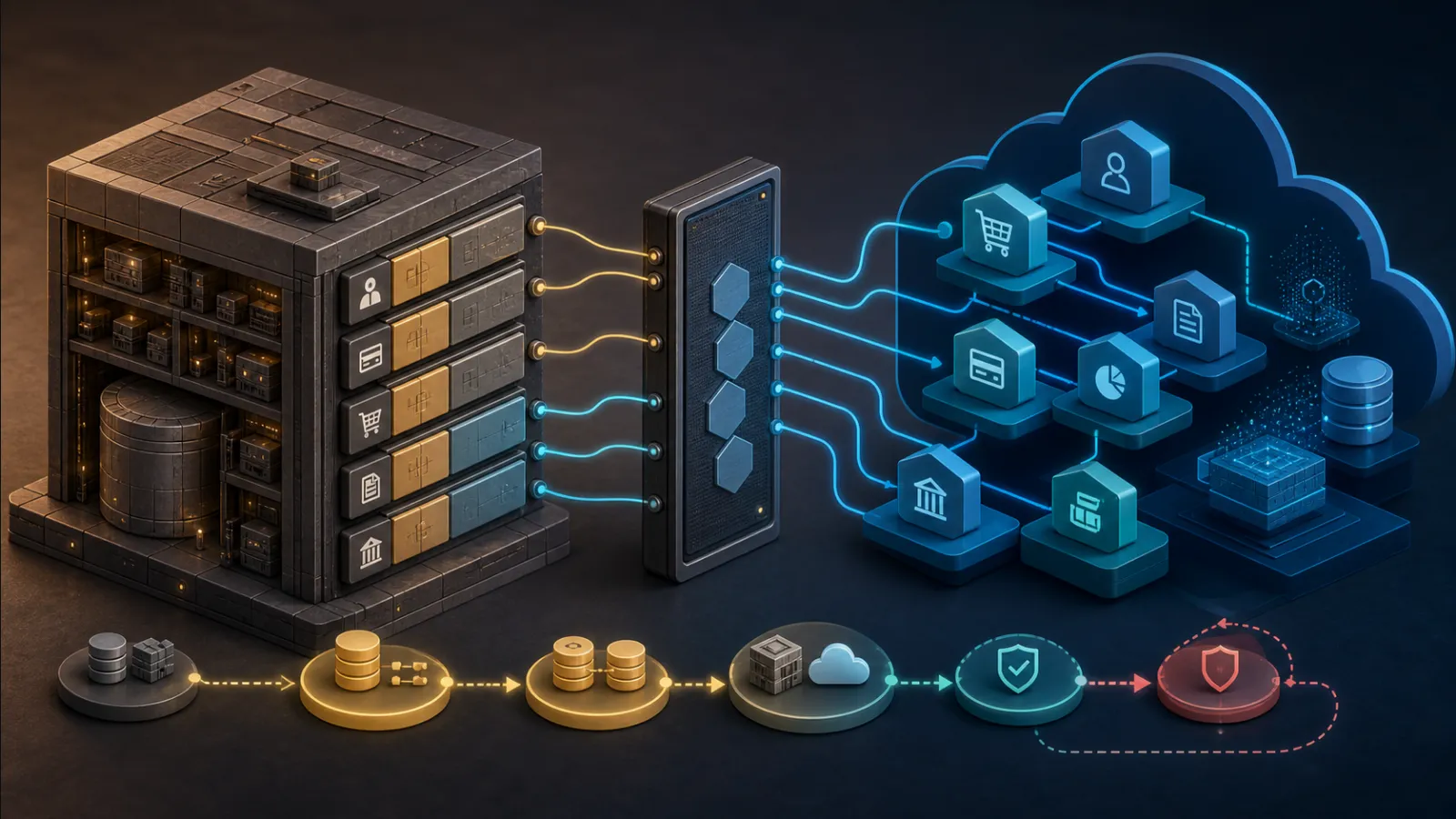
Reject the false choice between keeping everything and replacing everything
Legacy-software discussions often begin with two positions: tolerate the current system or approve a multi-year replacement. Neither reflects how most business systems are composed. A stable calculation engine, fragile user interface, obsolete identity system and valuable historical database do not all deserve the same treatment.
Modernisation is a portfolio of decisions. Some components should be retained and supported. Some need an API boundary, runtime upgrade or operational improvement. Commodity capabilities may be better replaced by a product. Unused functionality should be retired rather than migrated.
This changes the investment question from “How much will a new system cost?” to “Which constraints are costing the business most, and what is the smallest credible intervention that removes each one?”
Start with business constraints, not a technology inventory
A list of servers, frameworks and databases is useful, but it does not explain why modernisation matters. Link technology limitations to observable consequences: pricing changes take twelve weeks, acquisition data cannot be integrated, staff rekey orders, recovery depends on one person or a security control cannot be implemented.
Rank constraints by impact, urgency and reversibility. An unsupported internet-facing component may demand immediate containment. A slow internal reporting module may justify improvement only when the organisation next changes its reporting model.
Include the cost of doing nothing over a defined period. That is not merely hosting and maintenance; it includes incidents, manual work, assurance, blocked change and expiring vendor or staff dependencies. Avoid speculative revenue claims. Use real delayed initiatives, tender requirements and operational volumes where possible.
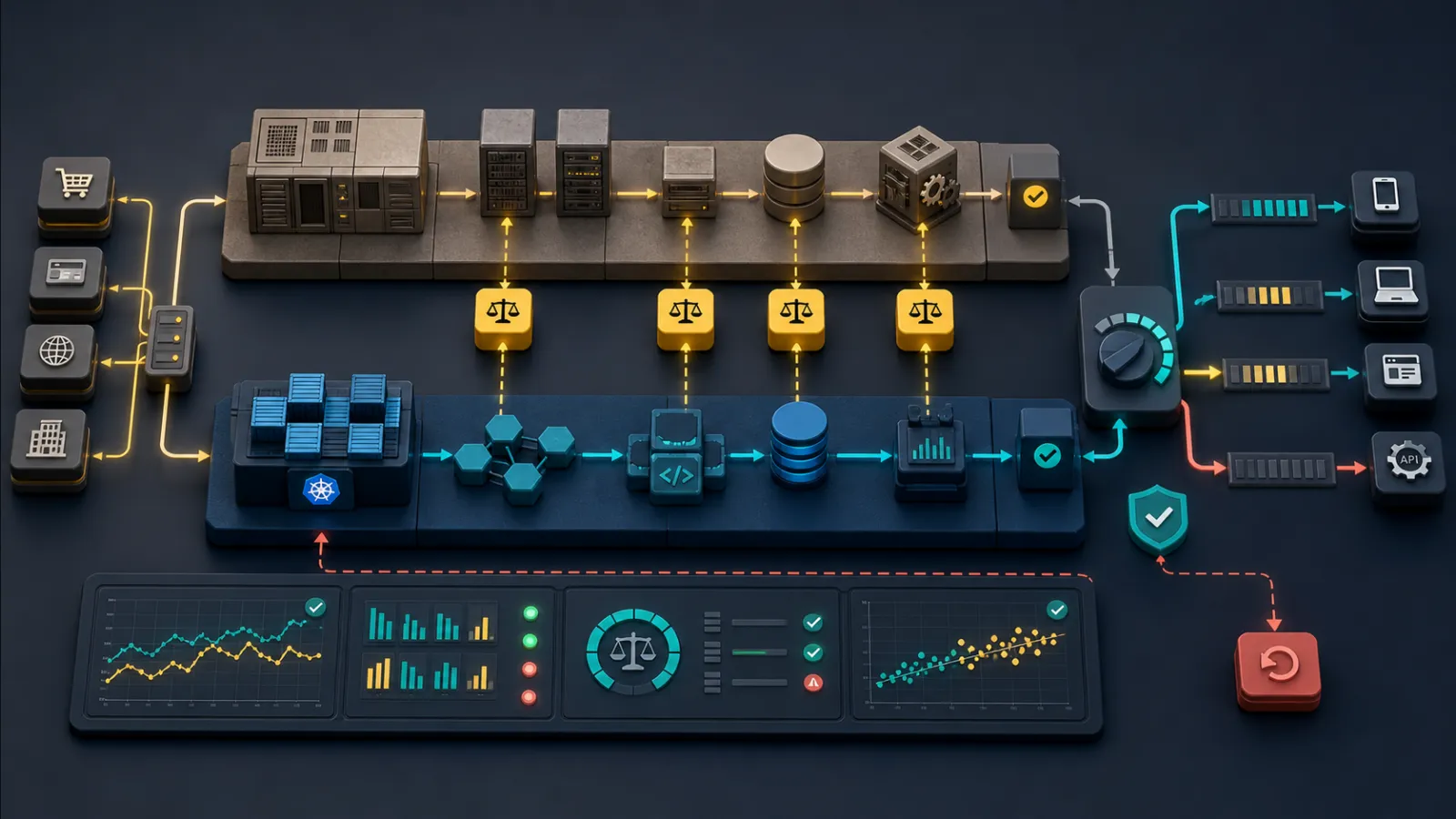
Map capabilities rather than applications
One application may contain customer onboarding, pricing, billing, document generation and reporting. Several applications may collectively provide one order-to-cash journey. Application boundaries therefore make poor modernisation units.
Map business capabilities, their owners, users, data, integrations and rate of change. Note where a capability is duplicated or where the same term means different things across departments. These semantic disagreements often cost more than the old framework.
Then map dependencies between capabilities. A visually isolated screen may write a table used by six nightly jobs. A shared customer table may conceal different ownership rules for sales, support and finance. Modernising around capability exposes those contracts before they become migration surprises.
Give each capability an explicit treatment
| Treatment | Use it when | Typical evidence |
|---|---|---|
| Retain | The capability is stable, supported and economical | Low change demand, acceptable risk and proven recovery |
| Stabilise | Behaviour remains valuable but operation is fragile | Weak tests, manual deployment, poor observability or concentrated knowledge |
| Rehost or replatform | Infrastructure or runtime is the main constraint | Hosting risk, capacity limits or support deadline |
| Refactor or extract | Frequent business change is blocked by coupling | Long lead time and repeated cross-system coordination |
| Replace | The capability is commodity and a suitable product exists | Limited differentiation and acceptable process adaptation |
| Rebuild | The capability differentiates the business and cannot be separated economically | Unique rules, strategic value and evidence that a rewrite risk is manageable |
| Retire | The outcome is no longer needed or is duplicated elsewhere | No valid consumers after a governed dependency review |
The treatments can be sequenced. Stabilise a component to reduce immediate operational risk, then replace it after a dependent product launches. Rehost an application to meet a data-centre deadline without pretending the move has resolved its internal design.
Modernise the operating model before the architecture demands it
Automated builds, repeatable environments, tested backups, secrets management and useful telemetry often deliver value before a line of business logic moves. They also make later change safer.
Do not begin by splitting a monolith into services if the team still deploys manually and cannot trace a user journey. Distribution multiplies deployment, network and ownership demands. A modular monolith on a supported runtime may be a more modern and economical outcome.
Make operational ownership explicit. A new component needs a team able to release, monitor and recover it. Architecture cannot compensate for a governance model in which every change crosses several disconnected groups.
Use boundaries to create choice
A façade can give consumers one stable interface while requests move between old and new implementations. An anti-corruption layer can translate legacy terminology and data shapes so new components do not inherit them. These patterns create optionality; they are not the modernisation outcome themselves.
An API wrapper around a legacy system does not make that system modern. It may reduce consumer coupling, improve authentication or expose usage evidence, which can be valuable. But it also adds latency, failure modes and another service to operate.
Record whether each boundary is permanent or transitional. A permanent integration interface needs product-level support. A transitional adapter needs a removal condition and funded deletion work. Without that distinction, every bridge becomes infrastructure.
Data ownership determines whether modules are truly separate
A module does not own a capability if another application can update its tables directly. Shared database writes allow fast initial delivery but preserve hidden coupling and make independent change unsafe.
Assign one authoritative owner for each business fact at every transition stage. Other components should consume a contract, replicated read model or governed export. Replication creates copies, not multiple sources of truth.
Avoid application-level dual writes where two databases must succeed together. Use explicit patterns such as an outbox, change-data capture or controlled migration pipeline, depending on consistency needs. Define lag, replay, duplication and reconciliation before cutover.
Historical data need not all move into the new transactional model. Frequently accessed records may migrate, while older history remains in a read-only archive with a clear retrieval and retention policy.
Fund coexistence as real delivery work
During transition, the organisation may operate two runtimes, duplicated monitoring, data synchronisation, routing, user support and reconciliation. Business cases that compare today's run cost with the future target but omit this middle period understate both cash and staff requirements.
Budget for migration tooling, test environments, data correction, security assessment, training and deletion. The cost peak may occur before legacy savings begin. Make that curve visible so pressure does not remove reconciliation or retirement work late in the programme.
Limit work in progress. Starting ten migrations creates ten coexistence boundaries and little completed value. Finish a small number of capabilities through retirement before opening more fronts.
Choose increments that change a business outcome
Technical milestones such as “database provisioned” or “API created” are necessary but do not prove the investment works. An increment should enable a real user journey, reduce manual work, remove an exposure or make a representative change faster.
A good first increment is bounded enough to complete but important enough to test the delivery model. Migrating an unused utility proves little. Starting with the most entangled revenue process may expose every risk at once. Look for a capability with measurable value and manageable dependencies.
Include security, data, telemetry, support and recovery in the slice. A prototype that demonstrates only the user interface postpones the hardest evidence.
Separate deployment from release and cutover
Deploy new software without immediately exposing it. Replay governed historical inputs, run in shadow mode or enable a small cohort through controlled routing. Compare business outcomes, not merely response codes.
Feature flags can control exposure, but they cannot reverse data changes or external actions. Define what rollback means for records created under the new rules, messages already sent and integrations already called.
Parallel running is useful only with an owner and an exit condition. Differences need classification and reconciliation. If old and new results are never compared, dual operation provides comfort rather than evidence.
Do not modernise undocumented workarounds by accident
Users often maintain spreadsheets, email approvals or manual corrections because the formal application does not cover reality. These practices may reveal necessary controls, obsolete policy or simple product gaps.
Observe the work before automating it. Preserve valuable judgement and separation of duties; eliminate repetitive translation and duplicate entry. Copying every workaround into code can fossilise a process the business should simplify.
Adoption belongs inside the modernisation scope. If the new route requires extra effort or removes a trusted control without explanation, users will retain the old path and the organisation will fund both.
Measure convergence, not activity
| Measure | Evidence of progress | Warning sign |
|---|---|---|
| Business constraint | Lead time, failure or manual effort falls | More software delivered with unchanged outcomes |
| Legacy footprint | Runtimes, licences, jobs, interfaces and tables are retired | New estate grows while old spend remains flat |
| Coexistence | Adapters and replicated flows have declining usage | Temporary bridges gain new consumers |
| Ownership | Teams can deploy and recover their capabilities | Every release still needs central coordination |
| Economics | Total run and change cost follows the expected curve | Savings exclude migration and duplicated operation |
Story points, code converted and cloud resources created measure activity. A modernisation programme converges when constraints disappear and the legacy footprint shrinks.
Set stop conditions as well as success measures
Incremental delivery provides opportunities to change course. Use them. Define evidence that would cause the organisation to pause, select a product instead, retain a stable module or reconsider the proposed boundary.
Warning signs include reconciliation consuming more effort than expected, a supposedly bounded capability revealing pervasive dependencies, adoption remaining low or the replacement failing to improve its target outcome.
Stopping an approach is not failure when it prevents a larger commitment based on false assumptions. The value of increments is learning before the irreversible spend.
A practical portfolio sequence
- Identify the few constraints with the largest business consequence.
- Map affected capabilities, data ownership and dependent journeys.
- Assign retain, stabilise, rehost, refactor, replace, rebuild or retire treatments.
- Strengthen delivery and recovery controls needed by every later increment.
- Select one valuable vertical slice and test its riskiest dependency.
- Deliver through controlled exposure, reconciliation and user adoption.
- Remove the replaced route, data flow and operating cost before expanding.
- Reassess the portfolio using what the completed increment revealed.
Questions leaders should settle before funding
- Which measurable business constraint will the first investment remove?
- What is being retained, and why is retaining it the better decision?
- Who owns each capability and authoritative dataset during transition?
- How much dual-running and reconciliation cost is included?
- Which adapters, flags and replicated stores are temporary?
- What evidence permits cutover, rollback or a change of strategy?
- Which old licences, infrastructure and support obligations will actually end?
- How will users adopt the new workflow rather than preserve the old one?
Related C3 Software guides
Frequently asked questions
Does incremental modernisation always cost less than replacement?
No. Coexistence and reconciliation add cost. Incremental change is attractive when it reduces risk, releases value earlier or preserves worthwhile capabilities-not simply because each approval is smaller.
What should be modernised first?
Start with a capability connected to a costly constraint, with observable outcomes and manageable dependencies. The easiest component is not necessarily the most informative investment.
Can a legacy application simply be wrapped with APIs?
An API can protect consumers and create a seam, but it does not fix internal coupling, data quality or unsupported technology. Give the wrapper a clear purpose and lifecycle.
How do we stop an incremental programme lasting forever?
Fund retirement in each increment, limit concurrent migrations and track deleted infrastructure, interfaces and operating costs alongside new delivery.
Choose the smallest modernisation move that changes the business
C3 Software Limited has built and supported business software in the UK since 2001. If a portfolio needs a practical route away from legacy constraints, talk to C3 Software about a focused assessment and staged modernisation roadmap.